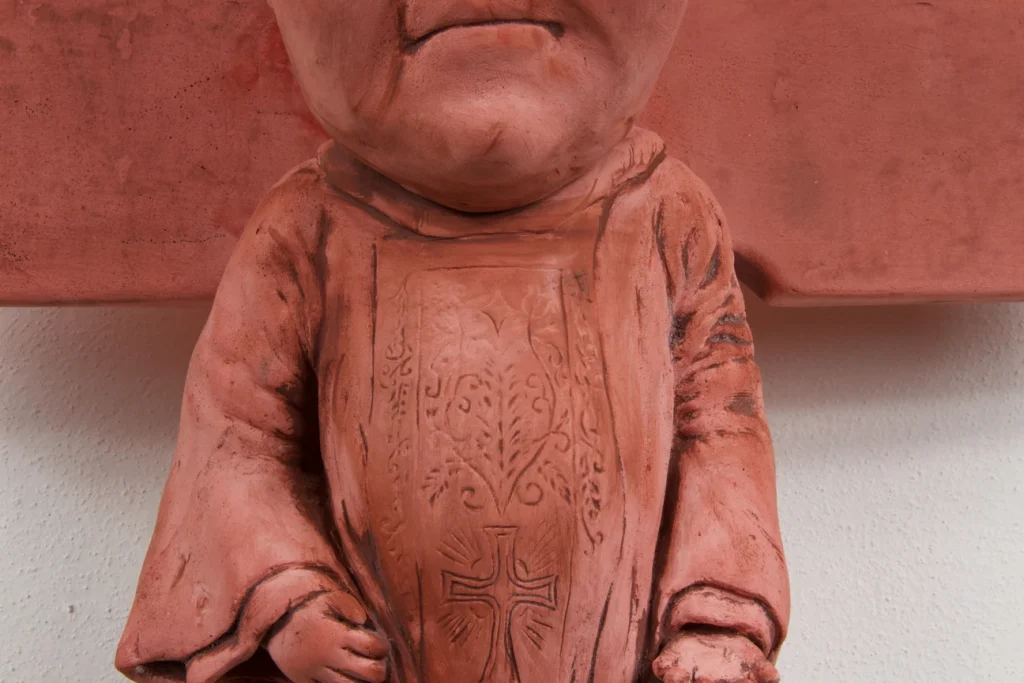
Choosing Luca Morini, known in Italy as “Don Euro,” as the protagonist of our work symbolizes the tensions between power, religion, and morality that run through so many modern institutions. We were in contact with Mangiacapra, who exposed this scandal, commented on our work, and supported us.
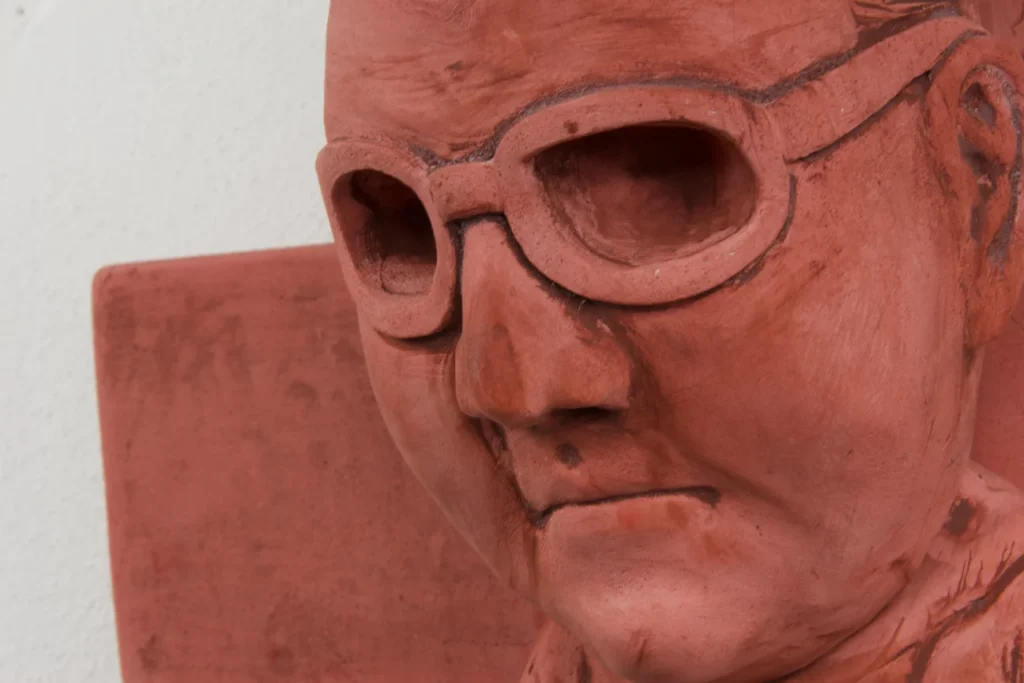
Don Euro, known for the ease with which he spent the embezzled money of the faithful on parties, luxury dinners, vacations, and sexual relationships despite being a priest, faces charges from the Apuanian prosecutor’s office for extortion, self-laundering, possession and sale of drugs, and substitution. All this is also alleged by a 28-year-old Neapolitan, a law student with blond hair, blue eyes, a sculptural physique, and who works as an escort. When Mangiacapra recounted how he met Morini and described their encounters, he was frequently stopped by Judge Ermanno De Mattia due to the gruesome and shocking details that came to light in court.
Corriere della Sera
For us, the cross is far more than a religious symbol, it is a stage on which the failings and weaknesses of human nature play out. The depiction of Don Euro on the cross is not about attacking him as an individual but about highlighting the role of the institutions that bring forth such figures and then let them fall. Society, which condemns these people and uses them as scapegoats, often forgets that the system itself keeps creating these “Don Euros.”
Our work is meant to challenge the viewer to think about power structures within the church and beyond. Why are individuals spotlighted and condemned while the mechanisms that created them persist? Our art aims to raise these questions out loud, exploring boundaries that others might not dare to cross.

With our Cruxials, we also address modern society’s fascination with sensation and scandal. The act of crucifixion here is a statement about how easily someone is demonized to distract from other issues. For us, Don Euro becomes a symbol of a society that prefers to judge the misconduct of individuals rather than question the systemic causes. How many “Don Euros” are out there? And how many such cases remain hidden because they don’t fit the media narrative of outrage?
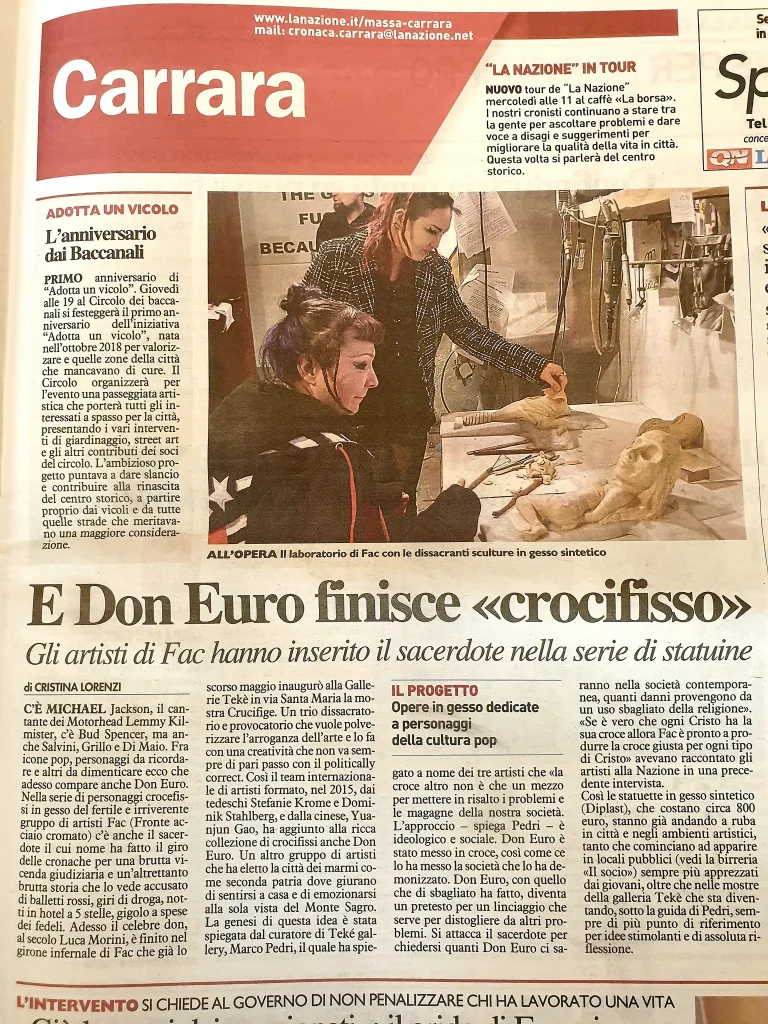
Our decision to display the statuettes of Don Euro and other “crucified” figures not only in galleries but also in everyday spaces like pubs was made deliberately. Art should be where people are, sparking reflection without appearing elitist or unreachable. Pricing each statuette at 800 euros makes the work accessible and gives it a practical presence that enhances its impact. We want our art to accompany people in their daily lives, holding up a mirror that encourages them to question their own beliefs and the institutions around them.


With our work, we want art to be understood not just as a beautiful object but as a tool for provocation, discourse, and reflection. We see ourselves as a collective, unbound by “political correctness,” as a trio that deliberately and creatively challenges societal expectations. Art should disturb, shake up, and shock. In a world shaped so strongly by social media and quick judgments, we see it as our duty to create a space for deeper reflection and engagement. Cruxials.
Our approach to portraying the former priest Luca Morini from Caniparola [Massa], alias “Don Euro,” underscores the urgency of our message: Morini is known in Italy for his misconduct, revealing a dark side of religious institutions. The “priest” guilty of embezzling funds to finance a life of luxury and pleasure represents the dark side of systems often seen by society as moral support. We stage him on the cross, (the symbol of suffering and redemption) to expose the hypocrisy and decay of ethical values within the church. The crucifixion thus becomes an ironic memorial against the self-righteous defense of power and morality.

From our perspective, using such a significant symbol as the cross is provocative and a powerful act of exposure. The installation forces us to question the role of religious institutions and their representatives, rather than accepting them uncritically as moral authorities. We used the cross not as a mere provocation but as a platform to raise societal questions: To what extent do we, as a society, contribute to the creation of such figures? Are such “Don Euros” isolated cases, or do they reflect a structural problem?
FAC’s work, however, goes beyond mere criticism of religion. With our installation, we address society’s need for scapegoats and blame. Curator Marco Pedri explains that Morini’s crucifixion is an “ideological and social” approach, showing how easy it is to demonize an individual while overlooking the larger, structural issue. The work encourages self-reflection: How often do we condemn individual “guilty” parties without questioning the underlying mechanisms?
As an artist collective also engaged in exploring the power of media and modern public opinion, addressing contemporary social and moral questions inspires us. We use the cross not just as provocation but as a vehicle to reveal layers of society that often go unexamined. This multifaceted approach appeals to us as it blurs the boundaries between art and political statement, underscoring the artist’s role as provocateur and thinker.
In an era where we quickly become judges over public figures through digital platforms, we open space for a deeper reflection on condemnation, guilt, and social responsibility. The artwork prompts us to pause and question whether our readiness to judge often conceals other, deeper issues.

Finally, it should be said that with the Cruxials series, FAC tries revitalizes art as a medium for enlightenment and critique, making a crucial contribution to modern, socially critical art. Our works are not just provocation but also a call for society to become aware of its responsibilities and to dare to look beneath the surface. Don Euro was and is presented to the public in various places.
Carrara 2021